
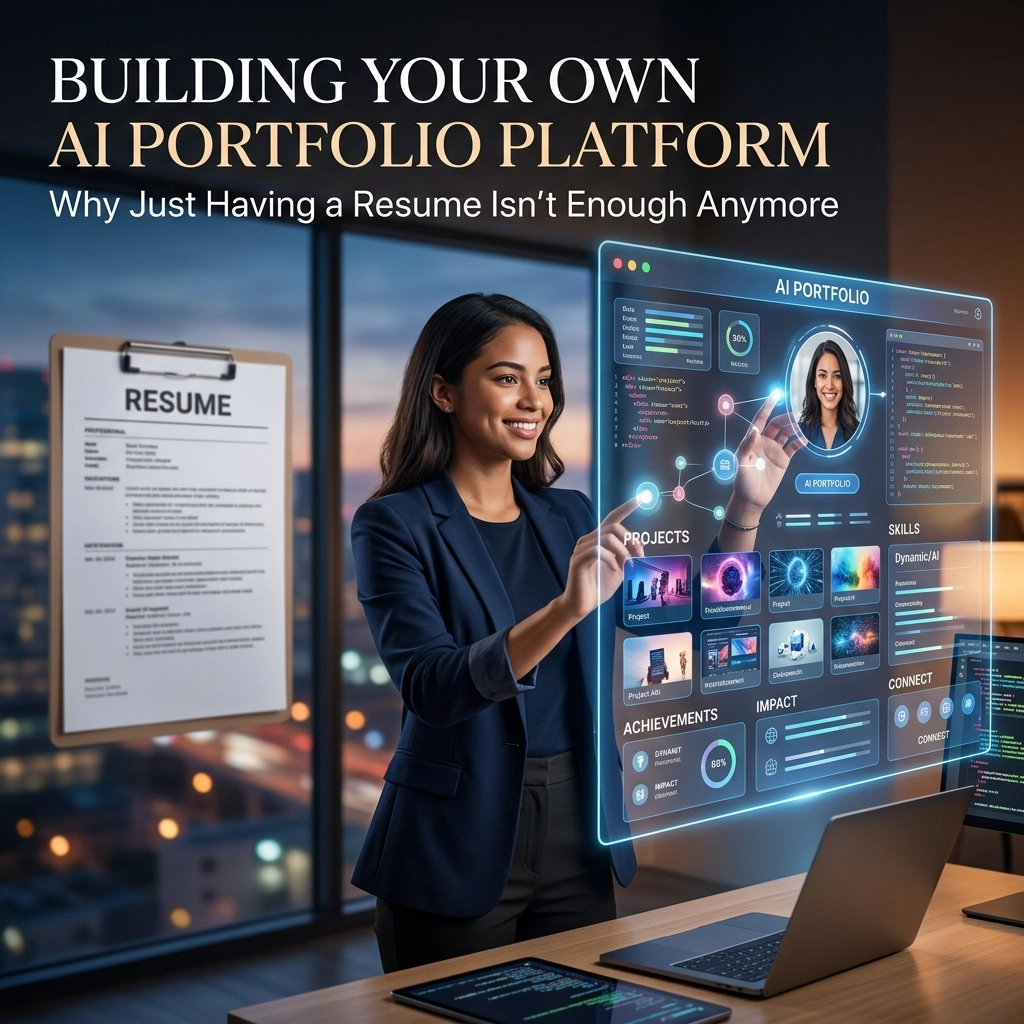

The 2026 job market feels very different than it did just a few years ago. Tech layoffs have changed how companies hire. Healthcare organizations have also pulled back in a lot of areas. Hiring cycles are slower, teams are more selective, and a lot of solid candidates are getting filtered out before a real human ever understands what they can actually do.
That is a big reason I built an AI-queryable portfolio instead of relying on a resume alone.
A resume still has a place. You usually need one for the system. But the traditional pipeline is broken. It is reactive, crowded, and built to reduce people into keywords, job titles, and short bullet points. That might help an ATS sort a pile of applications, but it does not do a great job of helping someone understand who you are, how you think, or whether you are actually a good fit.
That is the real shift happening now. It is not just about standing out anymore. Everyone can stand out on paper with the right formatting, polished language, and AI-assisted resume editing. The real challenge is being understood.
The 2026 Job Market Is More Selective Than Ever
A lot of candidates are still using the same playbook: apply, wait, follow up, repeat. The problem is that employers are moving slower and asking tougher questions.
In 2026, many companies are:
- Hiring more cautiously after layoffs in tech and healthcare
- Taking longer to make decisions
- Looking for tighter role alignment instead of "close enough"
- Expecting proof, not just claims
That creates a frustrating process for job seekers and freelancers alike. You can have strong experience and still get lost because your background does not line up perfectly with a keyword scan.
This same issue shows up in business buying decisions too. Companies looking for small business IT support, technology consulting for small business, or IT strategy consulting for SMEs are often flooded with generic providers that all sound the same. The same thing happens in hiring. Too many profiles look polished, but not many feel real.

The Traditional Pipeline Is Broken
The old hiring model is mostly reactive. You wait for a role to open, shape your background into the posting, send your resume, and hope someone connects the dots.
That process has a few obvious problems:
- It turns real experience into compressed bullet points
- It rewards keyword matching over actual clarity
- It pushes people to sound more impressive instead of more honest
- It hides the context behind your work
A resume can tell someone where you worked. It usually cannot explain how you solve problems, how you communicate, what kind of team you work best with, or where you are not a fit.
That last part matters more than people think.
From Standing Out to Being Understood
For a while, the advice was simple: make your resume stronger, make your branding sharper, and make your story more polished.
Now I think that advice is incomplete.
In a market where AI can help almost anyone create a clean, impressive resume, standing out is not enough. A lot of candidates now look optimized. Very few feel understandable.
Being understood means being direct. It means making it easy for someone to ask the real questions and get real answers. Not the rehearsed version. Not the over-edited version. The honest version.
That is why I built my portfolio the way I did.
The Core Idea: An AI-Queryable Portfolio
Instead of asking someone to read a static document and guess who I am, I wanted to create something more useful.
An AI-queryable portfolio lets someone ask direct questions like:
- What are your weaknesses?
- Why should we hire you?
- Are you a good fit for this role?
- What kind of work do you do best?
- What kind of environment do you not do well in?
- How do you approach technical problem-solving?
- What have you actually built?
That changes the interaction completely.
Instead of scanning bullet points, the recruiter, client, or hiring manager can have a direct conversation with the portfolio. They can explore the parts that matter most to them. They can go deeper into projects, decision-making, communication style, and outcomes.
It is less about presentation and more about clarity.

Why Honest Fit Assessment Matters
One of the most useful parts of this approach is what I call an Honest Fit Assessment.
Most resumes and portfolio sites are built to convince everyone. I do not think that is the right goal anymore.
A better goal is to help the right people quickly understand where there is alignment and where there is not.
That means being clear about:
- The roles that fit my strengths
- The kinds of problems I solve well
- The work style I prefer
- The environments where I am most effective
- The situations where I may not be the best fit
That last one is important. If a company wants someone who thrives in a highly rigid environment with very little autonomy, that may not be the best fit for every candidate. If a role needs deep specialization in an area outside my current focus, that should be said clearly too.
Being honest about fit saves time for everyone. It reduces wasted interviews, bad hires, and mismatched expectations. It also builds more trust than another polished paragraph ever will.
Why This Matters Beyond Hiring
This same principle applies in consulting and business technology decisions too.
When businesses are evaluating vendors for it infrastructure consulting services, digital transformation for small business, or it outsourcing for small business, they are not just looking for polished messaging. They want a provider that understands their situation and can clearly say what they do well, what they do not do, and where they can help most.
That is how trust gets built.
Whether you are hiring a person or hiring a consulting partner, the same rule applies: people want clarity before commitment.
The Infrastructure Still Matters
Even the best portfolio idea falls apart if the experience is slow, unreliable, or hard to navigate.
If you are building an AI-queryable platform, performance matters. Fast response times, stable hosting, and clean delivery make a real difference. That is especially true if you want recruiters, clients, or business owners to actually use the experience instead of bouncing after a few seconds.
If you need infrastructure that can support a more responsive and modern setup, take a look at this high-performance hosting solution.

What I Think Replaces the Resume
I do not think resumes disappear completely. They are still part of the process.
But I do think their role keeps shrinking.
The resume becomes the formal entry document. The real understanding comes from everything around it:
- Your portfolio
- Your work samples
- Your case studies
- Your communication style
- Your ability to answer direct questions honestly
That is where an AI-queryable portfolio becomes useful. It acts like a better front door. It gives people a faster way to understand whether there is a real match.
And in a slower, more selective market, that matters a lot.
Final Thought
I did not build an AI-queryable portfolio to be flashy. I built it because the old system does not do a good job of representing real people.
The traditional pipeline is too reactive. It compresses people into keywords. It rewards polish over clarity. And in the 2026 job market, that is not enough.
I would rather be understood than just look optimized.
If you are thinking about how tools like this connect to broader business systems, customer experience, or internal operations, that is exactly where smart IT planning makes a difference. For growing companies, the right mix of small business IT support, technology consulting for small business, and IT strategy consulting for SMEs can make digital systems more useful, more honest, and a lot easier to scale.
If you want help thinking through your next move, whether that is talent strategy, digital systems, or a broader modernization plan, Technology Consultant can help.
Ready to transform your digital strategy?
Call our receptionist at 16465364105.
Schedule a 30-minute consultation via Calendly: https://calendly.com/marvin-d-smith/30min
